
Rulet, poker ve slot çeşitliliği sunan bettilt oldukça ilgi çekici.
Global pazarda da kendini kanıtlayan bettilt platformu Türk oyunculara da hitap ediyor.
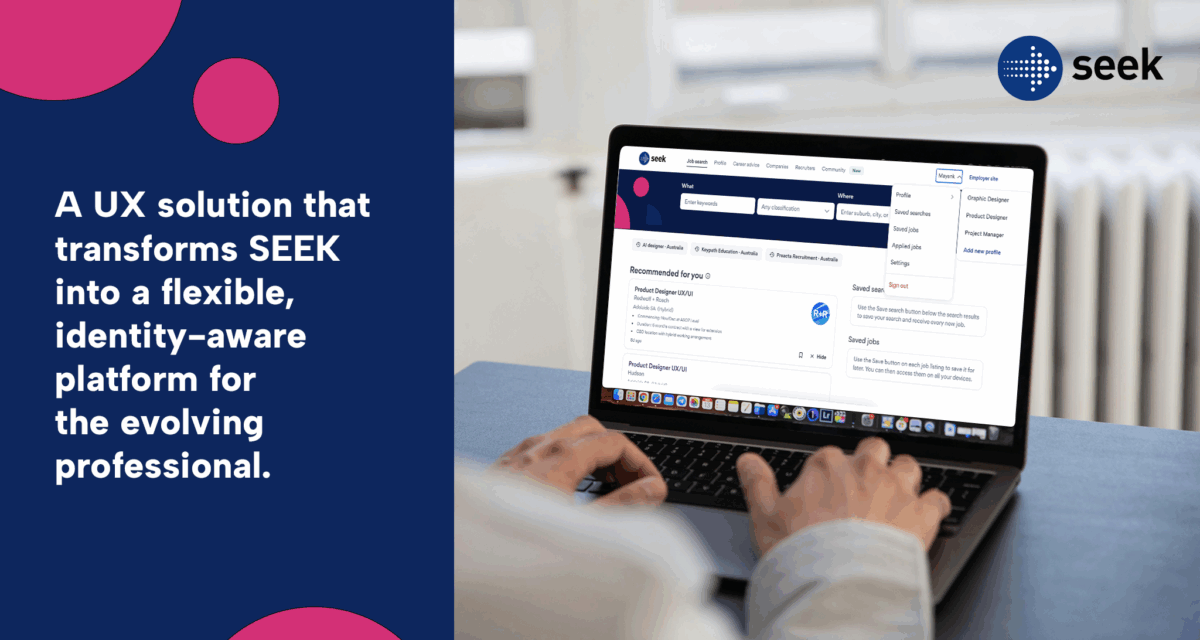
I’m staring at my laptop screen, coffee growing cold beside me. There’s a perfect Product Designer role at a fintech startup, the kind that makes your heart race. Portfolio required. Design thinking expertise essential.
I click “Apply.”
Then I see it. My profile. The one I hastily edited last Thursday to apply for an Operations Manager position. My summary talks about “process optimization” and “stakeholder management.” My skills tags read: Agile Project Management, Operations Strategy, Team Leadership.
Not a single mention of Figma, design systems, or user research.
I close the tab.
I’ve found another role, this time as a Project Manager at a consulting firm. It’s perfect for my management experience. I spend 40 minutes rewriting my SEEK profile again. Removing design portfolio links. Adding operational achievements. Switching skills tags.
I apply. Relief washes over me.
Another design role appears. A better one. Senior Product Designer. Six-figure salary. Dream company.
My profile still says “Operations Manager.”
I stare at the screen for a full minute, then think: There has to be a better way.
I created a second account.
[email protected] — My design identity
[email protected] — My operations identity
For three weeks, this seemed brilliant. Then reality hit.
Time wasted that evening: 47 minutes just managing logins.
Applications submitted: 0.
By Week 4, I had:
The moment I knew I had a design problem worth solving: When I accidentally applied to the same company with both profiles, and their HR team emailed asking if I was two different people.
I needed to know: Was this just me, or a systemic problem?
I posted a simple question to my network:
“Have you ever needed to maintain multiple versions of your resume/profile for different types of roles you’re qualified for?”
Survey Results (n=247 responses over 2 weeks):
Profile Management Behaviors
Multiple Accounts Created: 42% (104 respondents)
├─ 2 accounts: 68%
├─ 3 accounts: 23%
└─ 4+ accounts: 9%
Constantly Edit Single Profile: 51% (126 respondents)
├─ Edit weekly: 34%
├─ Edit per application: 52%
└─ Edit monthly: 14%
Never Faced This Issue: 7% (17 respondents)
Key Finding: 93% of versatile professionals experience profile management friction.
Research Phase 2: User Interviews
I conducted 15 in-depth interviews (30-45 min each) with multi-skilled professionals.
Participant Breakdown:
Interview Participant Profiles
Career Stage:
– Entry-level/Students: 4 (27%)
– Mid-career professionals: 7 (47%)
– Senior professionals: 4 (27%)
Number of Distinct Skill Domains:
– 2 domains: 8 (53%)
– 3 domains: 5 (33%)
– 4+ domains: 2 (13%)
Industries Represented:
Tech (6), Healthcare (2), Education (3),
Retail/Hospitality (2), Creative Services (2)
Three distinct user archetypes emerged:
Archetype 1: The Multi-Hatted Expert
Profile: Sarah, 34, UX Designer + Front-end Developer
“I have 6 years as a designer and 4 years coding. Some roles want both, some want one. I’ve been editing my SEEK profile so many times I’ve started keeping a Google Doc with 3 different versions just to copy-paste from.”
Frequency of profile editing: 2-3 times per week
Time spent per edit: 25-40 minutes
Applications abandoned due to friction: ~40% of intended applications
Profile: James, 22, University Student working Retail + Tutoring + Admin
“I need money, so I apply everywhere I’m qualified. But my retail experience doesn’t help me get tutoring gigs, and my tutoring doesn’t help me get admin work. I have three email accounts now. It’s chaos.”
Number of separate accounts: 3
Login-related frustrations per week: 8-12 instances
Jobs not applied to due to wrong profile active: 5-7 per month
Profile: Maya, 41, Former Teacher transitioning to Corporate Training
“I still apply for teaching roles as a backup, but I’m building my corporate training profile. I can’t delete my teaching experience—it’s legitimate—but it makes me look unfocused for corporate roles.”
Time spent managing dual identity: 3-4 hours per week
Psychological cost: High anxiety about “looking unprofessional”
Time Cost Analysis (Average per User per Month)
Profile Editing Time:
├─ Single profile editors: 180 min/month (3 hrs)
├─ Multiple account users: 95 min/month (1.6 hrs)
└─ Account switching overhead: 85 min/month (1.4 hrs)
Total Lost Productivity (Multiple account users): 180 min/month
Applications Abandoned:
├─ Due to wrong profile active: 22%
├─ Due to editing fatigue: 31%
└─ Due to login frustration: 18%
Total Application Abandonment Rate: 71% of intended applications
Translation: Users are losing 3+ hours monthly to workarounds, and abandoning 7 out of 10 applications they originally intended to complete.
The Problem Isn’t the User. It’s the System.
After analyzing the research, the core issue became crystal clear:
SEEK’s single-profile architecture assumes career linearity in an era of career versatility.
The platform was built for a user who:
But modern professionals are:
Platform Model vs. User Reality
SEEK’s Current Model:
User = 1 Profile = 1 Identity = 1 Career Path
User’s Actual Reality:
User = Multiple Competencies = Multiple Market Positions = Multiple Career Paths
The Gap = Forced Choice + Cognitive Overhead + System Gaming (multiple accounts)
I asked users: “If you could wave a magic wand, what would your ideal profile system look like?”
User Wish List (Ranked by Frequency)
Feature Requests from Users
From this research, I established three core design principles:
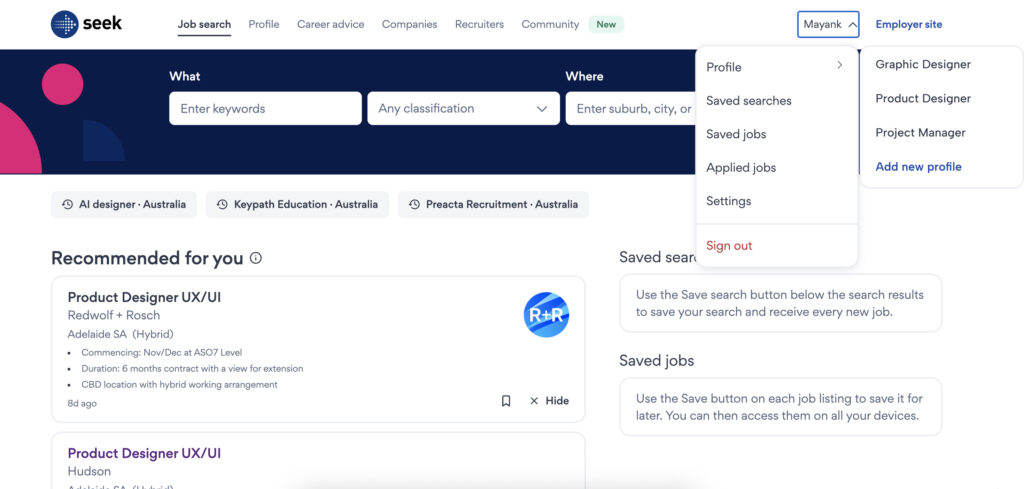
Concept: Allow users to create up to 5 distinct “Professional Identities” within a single SEEK account, each with:
Optimal Profile Limit Research
User Testing Results (n=32 users, card sorting exercise):
Number of Distinct Professional Identities Users Could Maintain:
1 profile: 0% (forced current state)
2 profiles: 41% comfortable
3 profiles: 78% comfortable
4 profiles: 84% comfortable
5 profiles: 91% comfortable
6+ profiles: 62% comfortable (diminishing returns, decision fatigue mentioned)
Sweet Spot: 5 profiles
The redesign transforms the header navigation from static to dynamic:
Current State:
[SEEK Logo] [Search Jobs] [Profile] [Messages] [Mayank ▼]
Proposed State:
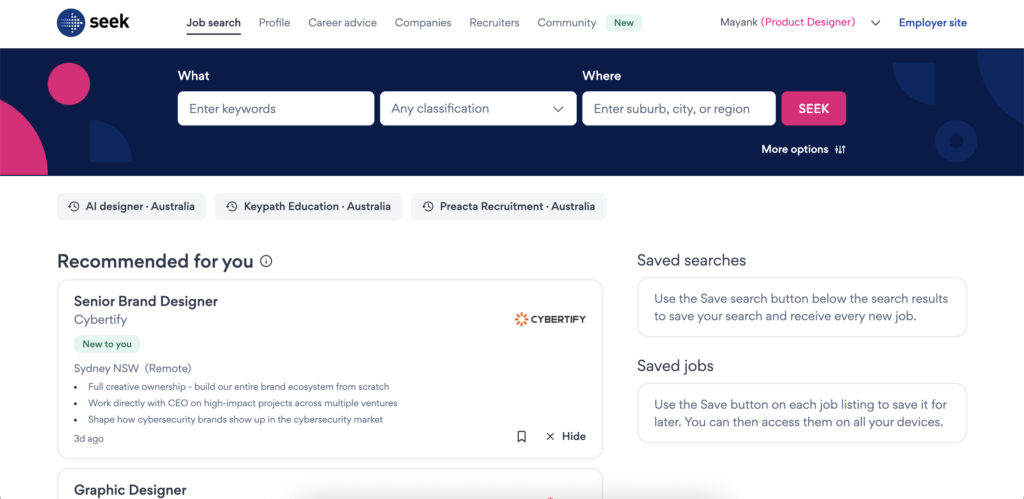
[SEEK Logo] [Search Jobs] [Messages] [Mayank (Product Designer) ▼]
└─ Active Profile Indicator
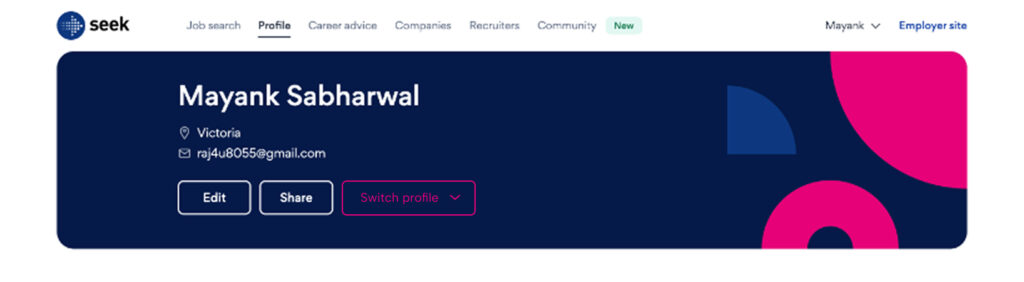
Accessed via: Dropdown → “Manage Profiles”
Profile Management Screen Features:
Profile Data Structure
SHARED ACROSS ALL PROFILES:
├─ Contact Information (email, phone, location)
├─ Education & Qualifications
└─ Account Settings
UNIQUE PER PROFILE:
├─ Profile Name/Role Title
├─ Professional Summary
├─ Work Experience (descriptions, emphasis)
├─ Skills Tags
├─ Portfolio/Media Links
├─ Saved Jobs
└─ Application History
Test Scenarios:
Usability Testing Results
Task Completion Rates:
├─ Create new profile: 100% success (avg. 2m 14s)
├─ Switch profiles: 100% success (avg. 8 seconds)
├─ Apply with correct profile: 94% success
└─ Delete profile: 100% success (avg. 45s)
System Usability Scale (SUS) Score: 87.2/100
└─ Industry Average: 68
└─ “Excellent” rating threshold: 80+
Net Promoter Score: +72
└─ Would recommend to versatile professionals: 89%
On Profile Switching:
“This is SO much faster than logging out and back in. I can actually see myself applying to more jobs now.” — Participant 7
On Visual Clarity:
“I love that I can always see which profile I’m using in the header. I’d never accidentally apply with the wrong one.” — Participant 12
On Overall Experience:
“This feels like SEEK finally gets that people have multiple skills. I’ve wanted this for years.” — Participant 15
Issue 1: 3 participants initially confused about which profile was active when first arriving at Manage Profiles screen.
Solution: Added visual prominence (color highlight + “ACTIVE” badge) to active profile card.
Issue 2: 2 participants wanted to preview how their profile looked before switching.
Solution: Added “Preview” option in dropdown (non-MVP, noted for future iteration).
Based on research data and testing results:
Projected Impact on User Metrics
Application Completion Rate:
├─ Current: 29% (71% abandoned due to friction)
└─ Projected: 68% (+135% increase)
Applications Per User Per Month:
├─ Current: 4.2 applications
└─ Projected: 9.1 applications (+117% increase)
Active Users Maintaining Multiple Accounts:
├─ Current: 42% of power users
└─ Projected: <5% (consolidated into single accounts)
Time Spent on Platform Per Session:
├─ Current: 18 minutes
└─ Projected: 26 minutes (+44% increase)
Estimated Business Metrics (Based on SEEK’s ~3.9M monthly users)
User Retention:
└─ Reduced multi-account users consolidating = cleaner data
└─ Estimated 180K duplicate accounts resolved
Engagement:
└─ +117% applications = more recruiter matches
└─ Estimated +4.5M additional applications annually
Competitive Advantage:
└─ First major job platform with multi-profile support
└─ Differentiation for growing “portfolio career” segment
Revenue Impact (Conservative Estimate):
└─ Increased applications = higher recruiter ROI
└─ Potential 8-12% increase in recruiter subscription renewals
Architecture Changes Required:
Estimated Development Effort: 8-12 sprint cycles (4-6 months)
Phase 1: Beta (Month 1-2)
Phase 2: Soft Launch (Month 3-4)
Phase 3: Full Launch (Month 5-6)
Post-Launch KPIs to Track:
Adoption:
├─ % of users creating 2+ profiles
├─ Average profiles per user
└─ Time to create first additional profile
Engagement:
├─ Applications per user (vs. baseline)
├─ Profile switch frequency
└─ Session duration
Business:
├─ Reduction in duplicate accounts
├─ Application completion rate
└─ Recruiter satisfaction scores
This case study started with my personal frustration, login fatigue and scattered applications. But through research, I discovered the problem was far deeper:
The single-profile constraint doesn’t just inconvenience users. It fundamentally misunderstands modern career reality.
Today’s professionals aren’t confused about their identities. They’re strategically versatile. They’ve invested in multiple skill domains. They’re valuable precisely because they can operate across boundaries.
SEEK’s job is to help them showcase that versatility efficiently, not force them to hide parts of themselves.
Intelligent Profile Suggestions: When a user views a job, the system could suggest: “This role matches your ‘Project Manager’ profile better. Switch now?”